
Klaviyo vs Mailchimp: Which Email Platform Is Better for Ecommerce?
When I talk to ecommerce founders about scaling revenue through email, one question comes up again and again: Klaviyo vs Mailchimp — which platform actually drives more sales?
This isn’t just a technical comparison. Choosing between Klaviyo vs Mailchimp directly impacts your retention, LTV, segmentation depth, and ultimately your bottom line. I’ve worked with dozens of ecommerce brands, and I’ve seen firsthand how the choice between Klaviyo vs Mailchimp can either unlock growth or quietly limit it.
In this article, I’ll break down Klaviyo vs Mailchimp from a strategic, data-driven, and practical perspective — not just features, but real-world performance.
Why “Klaviyo vs Mailchimp” Matters for eCommerce Growth
Email marketing isn’t just a communication channel anymore. According to a report by DMA:
“Email delivers an average ROI of $36 for every $1 spent.”
— DMA, 2024
But here’s what most brands miss: your platform determines how much of that ROI you actually capture.
That’s why the debate around Klaviyo vs Mailchimp is so important. The wrong choice can cap your automation capabilities, weaken segmentation, and reduce personalization — all of which are critical for eCommerce.
Klaviyo vs Mailchimp: Core Philosophy
Before diving into features, let’s understand the fundamental difference in Klaviyo vs Mailchimp.
Klaviyo: Built for ecommerce first
Klaviyo was designed specifically for online stores. Everything — from flows to segmentation — is revenue-focused.
Mailchimp: General Marketing Platform
Mailchimp started as a newsletter tool and evolved into a broader marketing platform. It’s versatile, but not deeply specialized.
This distinction is at the heart of Klaviyo vs Mailchimp.
Klaviyo vs Mailchimp: Feature Comparison Table
| Feature | Klaviyo | Mailchimp |
| Ecommerce Focus | Deep integration | Basic integration |
| Segmentation | Advanced behavioral | Limited |
| Automation | Highly customizable flows | Pre-built workflows |
| Personalization | Dynamic, real-time | Static variables |
| Analytics | Revenue-centric | Campaign-centric |
| SMS Marketing | Native | Add-on |
| Scalability | Excellent | Moderate |
When analyzing Klaviyo vs Mailchimp, this table already hints at a pattern: Klaviyo is built for revenue, Mailchimp for communication.
Klaviyo vs Mailchimp: Segmentation Power
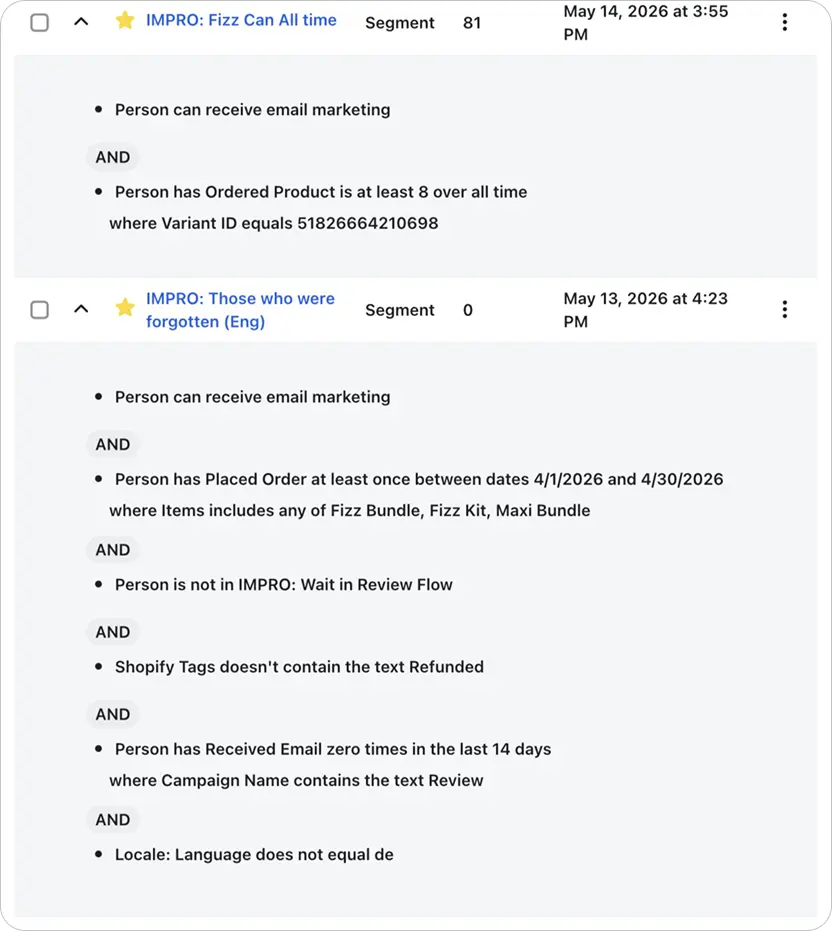
Segmentation is where Klaviyo vs Mailchimp really starts to diverge.
Klaviyo
- Real-time behavioral segmentation
- Predictive analytics (CLV, churn risk)
- Event-based triggers
Mailchimp
- Basic list segmentation
- Limited behavioral triggers
In the context of Klaviyo vs Mailchimp, segmentation isn’t just a feature — it’s a revenue driver.
According to McKinsey:
“Personalization can reduce acquisition costs by up to 50% and increase revenue by 10–15%.”
Klaviyo enables that level of personalization. Mailchimp struggles to match it.
Klaviyo vs Mailchimp: Automation & Flows
Automation is the backbone of eCommerce email marketing.
Klaviyo Flows
- Abandoned cart flows with dynamic product blocks
- Post-purchase upsell sequences
- Win-back campaigns based on inactivity
- Predictive send time optimization
Mailchimp Automation
- Basic drip campaigns
- Limited triggers
- Less flexibility in branching logic
When comparing Klaviyo vs Mailchimp, automation depth is one of the biggest deciding factors.
If you’re serious about lifecycle marketing, Klaviyo vs Mailchimp isn’t even a close competition.
Klaviyo vs Mailchimp: Integrations
Integrations define how well your platform fits into your stack.
Klaviyo integrates deeply with Shopify, WooCommerce, Magento, and more.
Mailchimp integrates widely, but often with less depth.
👉 For a deeper breakdown, check our internal guide.
In the Klaviyo vs Mailchimp comparison, Klaviyo wins in quality, Mailchimp in quantity.
Klaviyo vs Mailchimp: Analytics & Reporting
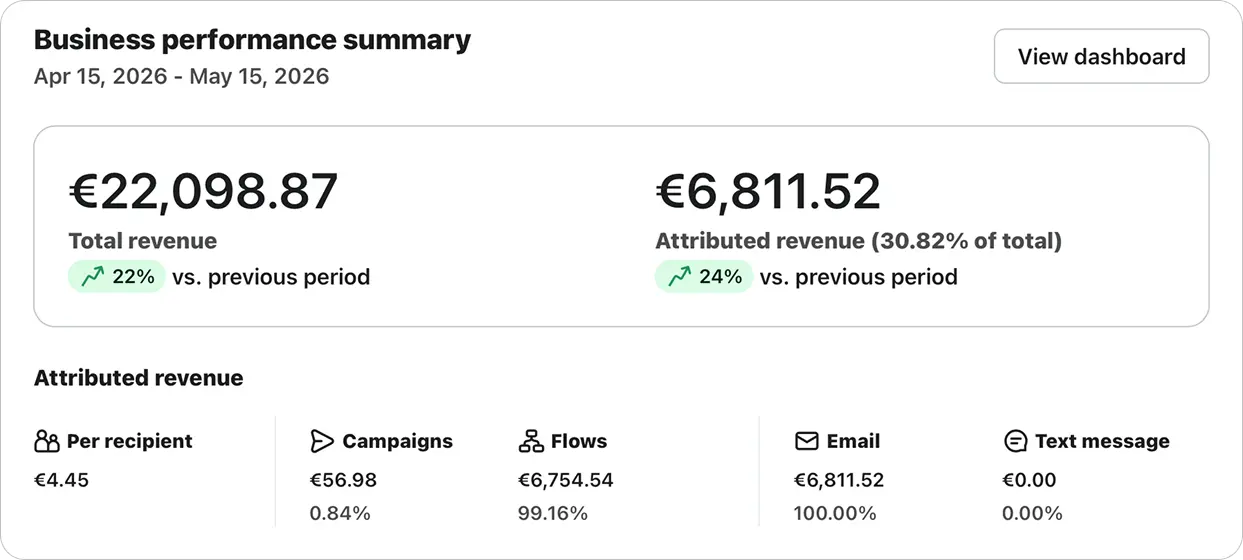
Data is everything in ecommerce.
Klaviyo
- Revenue attribution per email
- Customer lifetime value tracking
- Cohort analysis
Mailchimp
- Open rates
- Click rates
- Basic reporting
This is one of the most critical aspects of Klaviyo vs Mailchimp.
Because if you can’t measure revenue impact — you can’t optimize it.
Klaviyo vs Mailchimp: Pricing Reality
At first glance, Mailchimp seems cheaper.
But here’s the truth about Klaviyo vs Mailchimp pricing:
- Mailchimp charges for contacts regardless of engagement
- Klaviyo allows smarter list management
- Klaviyo often delivers higher ROI per email
So while comparing Klaviyo vs Mailchimp, don’t just look at cost — look at revenue per subscriber.
Klaviyo vs Mailchimp: Real Ecommerce Use Case
Let me give you a real scenario from our agency work.
A mid-sized Shopify brand switched from Mailchimp to Klaviyo.
Before (Mailchimp):
- Revenue from email: ~12%
- Limited automation
- Generic campaigns
After (Klaviyo):
- Revenue from email: 28%
- Advanced flows
- Hyper-personalized segmentation
That’s the real-world impact of Klaviyo vs Mailchimp.
Klaviyo vs Mailchimp: Deliverability
Deliverability is often overlooked in the Klaviyo vs Mailchimp debate.
Both platforms have strong infrastructure, but:
- Klaviyo gives more control over sender reputation
- Mailchimp is more “plug-and-play”
In Klaviyo vs Mailchimp, advanced users benefit more from Klaviyo.
Klaviyo vs Mailchimp: Ease of Use
Let’s be honest.
Mailchimp
- Easier for beginners
- Cleaner UI
- Faster onboarding
Klaviyo
- Steeper learning curve
- More complex setup
- Much more powerful
So in Klaviyo vs Mailchimp, it’s simplicity vs capability.
Klaviyo vs Mailchimp: Which Platform Wins?
After years of hands-on experience, here’s my honest take on Klaviyo vs Mailchimp:
- If you’re a beginner or a small business, Mailchimp can work
- If you’re serious about scaling ecommerce, Klaviyo is the clear winner
This isn’t hype. It’s based on performance.
Why We Recommend Klaviyo for eCommerce Brands
At our agency, we almost always recommend Klaviyo in the Klaviyo vs Mailchimp debate.
Why?
Because it aligns with how modern eCommerce works:
- Data-driven
- Personalized
- Automated
- Revenue-focused
Why does a store need Klaviyo? Learn more here.
How to Choose Between Klaviyo vs Mailchimp
If you’re still deciding between Klaviyo vs Mailchimp, ask yourself:
- Do you need advanced segmentation?
- Do you want to scale revenue through flows?
- Do you rely heavily on Shopify or WooCommerce?
- Do you want deep analytics?
If the answer is “yes” — then in the Klaviyo vs Mailchimp comparison, Klaviyo is your platform.
Alternative Tools Worth Considering
While this article focuses on Klaviyo vs Mailchimp, there are other tools worth exploring.
👉 Full breakdown here.
But in most ecommerce cases, the decision still comes back to Klaviyo vs Mailchimp.
Final Verdict: Klaviyo vs Mailchimp
So, which platform is better?
Klaviyo vs Mailchimp — Klaviyo wins for ecommerce.
Not because Mailchimp is bad — but because Klaviyo is purpose-built for revenue growth.
If your goal is:
- Higher LTV
- Better segmentation
- More automation
- Stronger ROI
Then the answer in the Klaviyo vs Mailchimp debate is clear.
Work With Experts
Choosing between Klaviyo vs Mailchimp is just the first step.
The real results come from:
- Strategy
- Setup
- Optimization
If you want to turn email into a major revenue channel, contact our team for a consultation.
FAQ:
What is the main difference between Klaviyo vs Mailchimp?
The core difference in Klaviyo vs Mailchimp lies in their focus. Klaviyo is built specifically for eCommerce, offering deep data integrations, advanced segmentation, and revenue-driven automation. Mailchimp, on the other hand, is a general marketing platform designed for a broader audience.
In the Klaviyo vs Mailchimp comparison, Klaviyo is optimized for maximizing customer lifetime value, while Mailchimp focuses more on ease of use and basic campaign management.
Is Klaviyo better than Mailchimp for Shopify stores?
Yes — in most cases, Klaviyo is significantly better for Shopify.
In the Klaviyo vs Mailchimp debate for Shopify, Klaviyo wins because of:
- Real-time data syncing
- Advanced segmentation based on purchase behavior
- Powerful automation flows (abandoned cart, post-purchase, win-back)
Mailchimp offers Shopify integration, but it lacks the depth needed for serious eCommerce growth. That’s why in Klaviyo vs Mailchimp, Shopify brands almost always choose Klaviyo.
Why do ecommerce brands switch from Mailchimp to Klaviyo?
This is one of the most common transitions we see.
Brands move in the Klaviyo vs Mailchimp journey because:
- They outgrow basic automation
- They need better segmentation
- They want revenue attribution, not just open rates
- They aim to increase email-driven revenue
In real-world Klaviyo vs Mailchimp scenarios, switching platforms often leads to a significant increase in email revenue.
Is Mailchimp cheaper than Klaviyo?
At first glance, yes — but the reality is more nuanced.
In the Klaviyo vs Mailchimp pricing comparison:
- Mailchimp appears cheaper at lower tiers
- Klaviyo becomes more cost-efficient as you scale
- Klaviyo often delivers higher ROI per subscriber
So while comparing Klaviyo vs Mailchimp, it’s critical to evaluate not just cost, but revenue potential.
Which platform is easier to use: Klaviyo vs Mailchimp?
Mailchimp is easier for beginners.
In the Klaviyo vs Mailchimp usability comparison:
- Mailchimp has a simpler interface and faster onboarding
- Klaviyo has a steeper learning curve but far more capabilities
If you’re just starting, Mailchimp may feel more intuitive. But in the long-term Klaviyo vs Mailchimp decision, Klaviyo offers significantly more power.
Can Mailchimp match Klaviyo’s automation features?
Not fully.
In the Klaviyo vs Mailchimp automation comparison:
- Klaviyo offers advanced flows with dynamic logic and real-time triggers
- Mailchimp provides basic automation with limited flexibility
For serious lifecycle marketing, Klaviyo vs Mailchimp is not an equal comparison — Klaviyo is far more advanced.
When should you choose Mailchimp over Klaviyo?
There are still cases where Mailchimp makes sense.
In the Klaviyo vs Mailchimp decision, choose Mailchimp if:
- You don’t run an eCommerce store
- You only need basic newsletters
- You have a very small list and limited budget
- You don’t need advanced automation
Otherwise, in most Klaviyo vs Mailchimp scenarios, Klaviyo is the better long-term investment.
Is Klaviyo worth it for small ecommerce businesses?
Yes — if you plan to grow.
In the Klaviyo vs Mailchimp comparison for small businesses:
- Klaviyo may feel complex initially
- But it prevents the need to migrate later
- It scales with your business
Choosing Klaviyo early in the Klaviyo vs Mailchimp journey can save time, money, and lost revenue in the long run.
How do I migrate from Mailchimp to Klaviyo?
Migration is straightforward but requires planning.
Typical steps in the Klaviyo vs Mailchimp migration process:
- Export contacts and segments
- Rebuild flows in Klaviyo
- Integrate your store (Shopify, WooCommerce, etc.)
- Warm up your sending domain
- Launch optimized campaigns
If you want to avoid mistakes during the Klaviyo vs Mailchimp transition, it’s best to work with experts.