8 Best Klaviyo Pop-up Examples in 2026 (With Real Conversion Data)
A Klaviyo pop-up is only as good as what it does after the click. From my point of view, the brands actually winning at this in 2025 and 2026 aren’t guessing – they’re testing specific formats against specific goals, and the results are documented and public.
Below are eight of the best Klaviyo pop-up examples I’ve found this year, each representing a distinct format: gamified, exit-intent, quiz-based, seasonal, fullscreen, minimal, multi-step, and AI-optimized. Every example includes the real result and where the format sits inside a broader Klaviyo strategy, so you can see not just what these Klaviyo pop-ups look like, but why they worked.
What Makes a Klaviyo Pop-up Actually Convert in 2026
Before diving into the examples, it’s worth naming the pattern that connects all of them: none of these brands used a single, generic “10% off” pop-up and called it done. Each one matched a specific pop-up format to a specific moment in the customer journey – first-time visitor, cart abandoner, high-intent browser – and then measured the result instead of assuming it worked. We go deeper into the mechanics of timing, triggers, and design in our complete guide to pop-ups in email marketing, which covers the foundational rules every one of these examples follows.
8 Best Klaviyo Pop-up Examples
1. Gamified Spin-to-Win
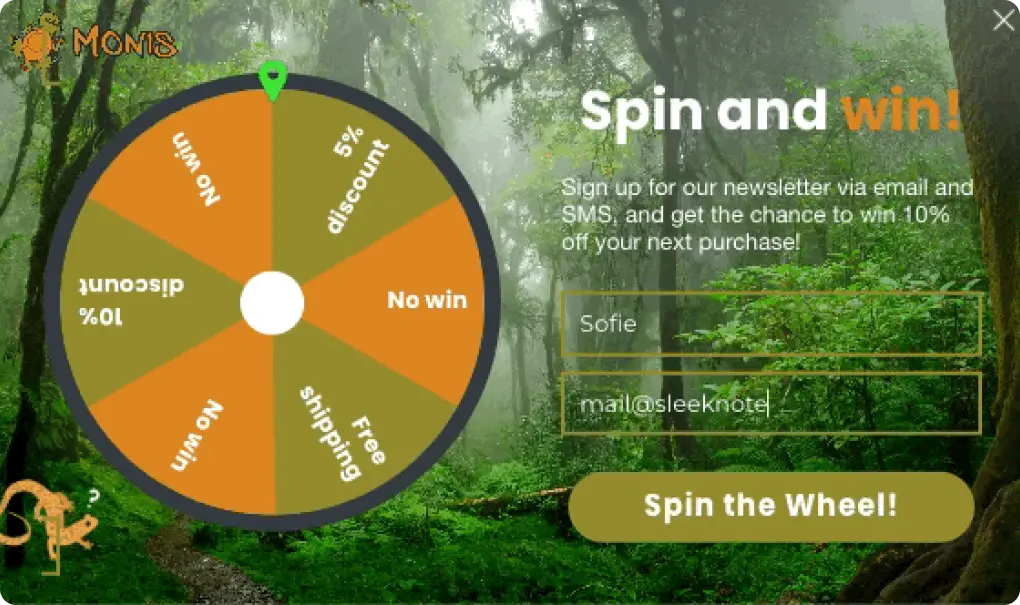
Onyx Cookware replaced a standard discount pop-up with a gamified Spin-to-Win wheel, synced directly into Klaviyo for welcome-flow follow-up. The gamified format alone boosted conversion to an exceptional 43.03% – dramatically above the 1.5–3% range typical of standard native Klaviyo pop-ups. The mechanism works because it reframes a data request as a game: visitors spin for a prize rather than filling out a form, which lowers the psychological cost of opting in.
2. Exit-Intent with Personalized Recommendations
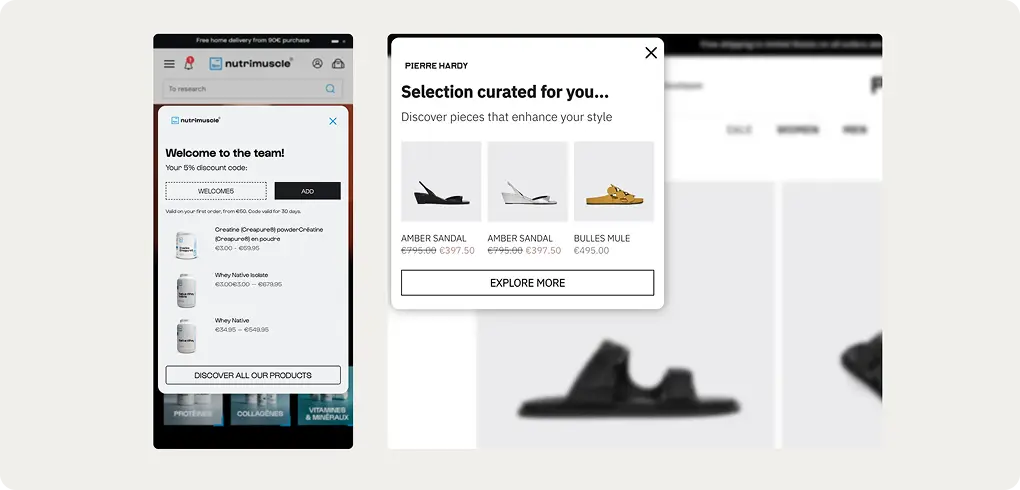
Luxury footwear brand Pierre Hardy built an exit-intent pop-up that fires only when a visitor shows signs of leaving, then serves personalized product recommendations pulled from that visitor’s browsing behavior. The campaign converted 565 visitors who would otherwise have left empty-handed. Exit-intent pop-ups typically convert lower than on-landing formats, but pairing the trigger with personalization – rather than a blanket discount – is what pushed Pierre Hardy’s numbers past the category average.
3. Quiz-Style Pop-up
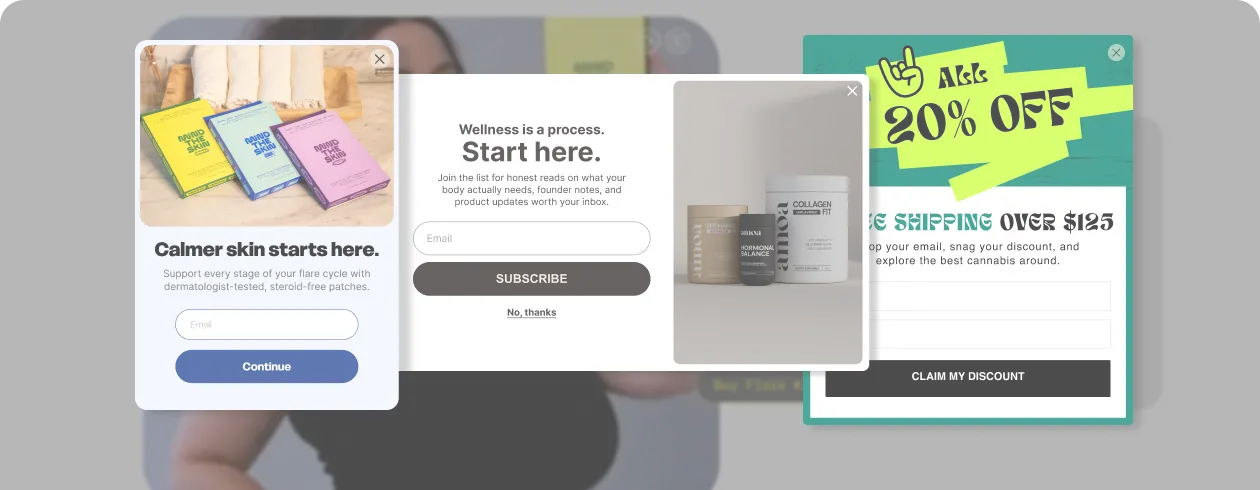
Topicals, a skincare brand running on Klaviyo, took a different route: instead of a static discount form, visitors answer a short, brand-voiced quiz before receiving their offer. The format keeps copy minimal and visually on-brand, which matters for a skincare audience that responds better to guided discovery than a flat percentage-off banner. Quiz-style pop-ups also double as a zero-party data tool – every answer becomes a segmentation input inside Klaviyo.

4. Seasonal Pop-up with a Gift Incentive
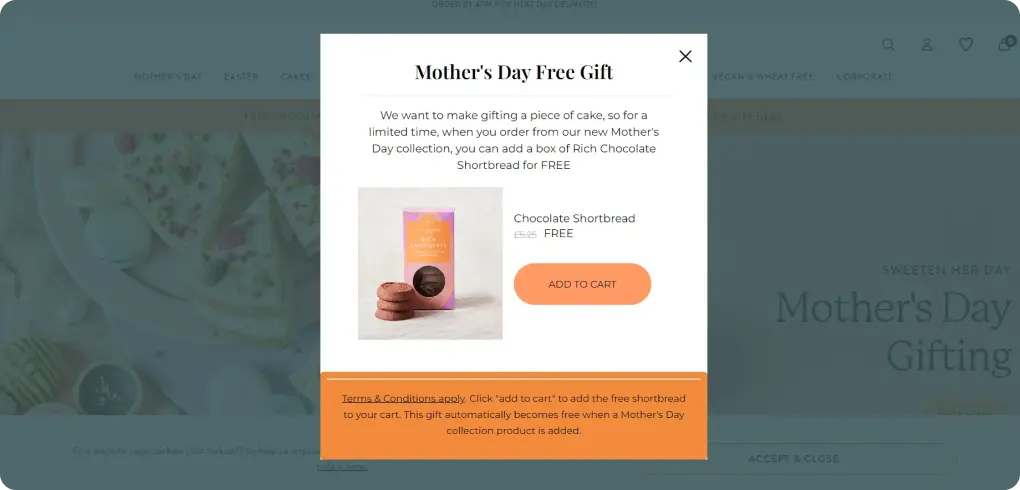
Rather than pushing a direct “shop now” message, Cutter & Squidge used a seasonal pop-up to promote a new collection with a free gift as the incentive. Framing the offer around a gift rather than a percentage discount shifts the pop-up from transactional to generous, which tends to protect margin better than a blanket discount while still converting well during seasonal traffic spikes.
5. Fullscreen Discount Pop-up
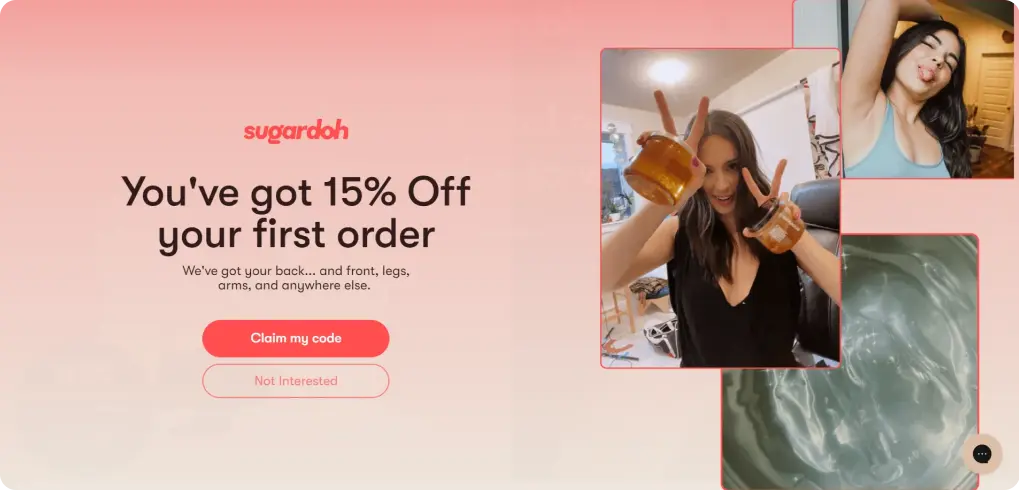
Sugardoh’s approach is the opposite of subtle: a vibrant, fullscreen pop-up with a clear, immediate discount and minimal copy. Fullscreen formats carry more risk on mobile – Google can flag intrusive interstitials, which hurts mobile SEO if implemented poorly – but Sugardoh’s execution keeps the message short enough to avoid feeling like a wall, making it a useful reference for brands that want maximum visual impact without the ranking penalty.
6. Minimal, Low-Friction Pop-up
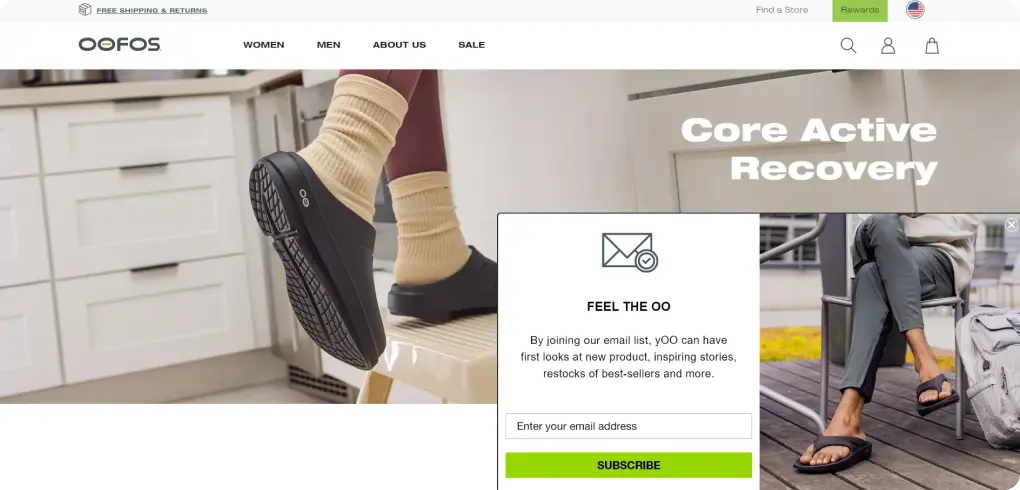
OOFOS takes a quieter approach: a small, understated pop-up that captures email without interrupting the browsing experience. This format won’t post the highest raw conversion numbers of the group, but it protects the shopping experience for a brand where trust and comfort are core to the product story – proof that the highest-converting pop-up isn’t always the right pop-up for every brand identity.
7. Two-Step Email-to-SMS Pop-up
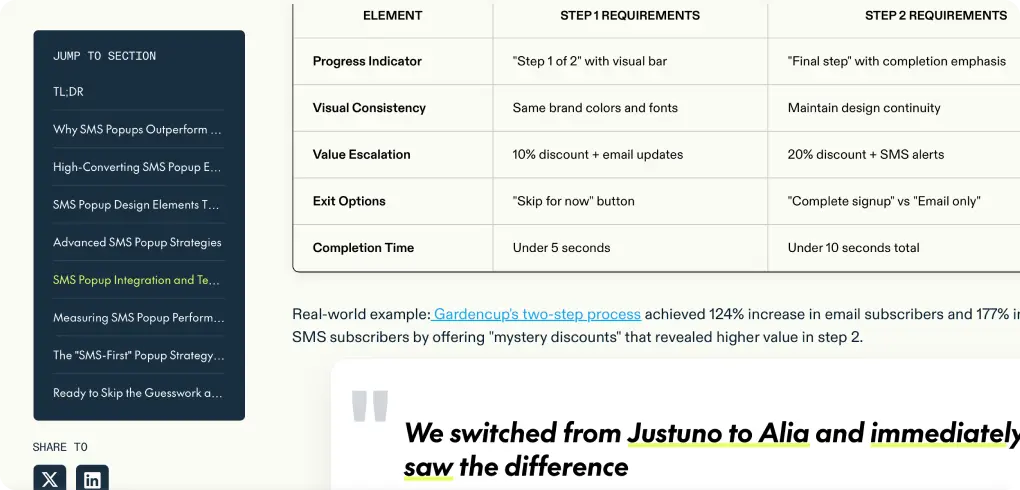
Gardencup’s two-step pop-up asks for email first, then reveals a bigger “mystery discount” if the visitor also opts into SMS on step two. The layered approach delivered a 124% increase in email opt-ins and a 177% increase in SMS opt-ins, along with a 76% lift in welcome-flow revenue. This format is one of the most effective ways to build both lists simultaneously without asking for everything upfront – each step only asks for one thing, which keeps friction low at every stage.
8. AI-Optimized Native Klaviyo Pop-up
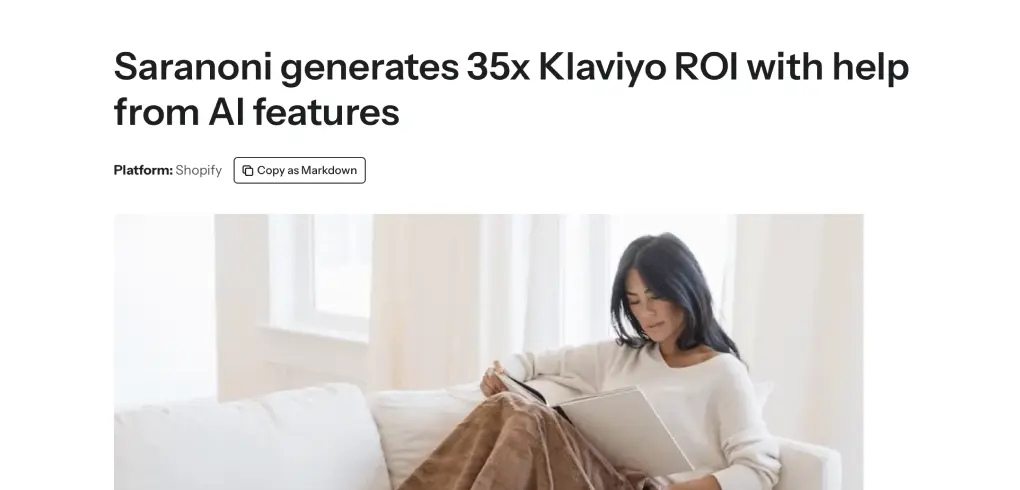
Saranoni used Klaviyo’s own AI-powered forms display optimization to test multiple placement and timing variations for their native pop-ups directly inside the platform. One winning variation alone drove a 14% lift in form submission rate, contributing to a broader 35x ROI across their Klaviyo program. This is the example to study if you want to stay entirely inside Klaviyo’s native tools rather than adding a third-party pop-up platform – proof that Klaviyo’s own AI testing can meaningfully move the needle without extra integrations.
Klaviyo Pop-up Examples at a Glance
| Brand | Pop-up Type | Key Result |
| Onyx Cookware | Gamified Spin-to-Win | 43.03% conversion |
| Pierre Hardy | Exit-intent + personalization | 565 conversions |
| Topicals | Quiz-style | On-brand, zero-party data capture |
| Cutter & Squidge | Seasonal + gift incentive | Margin-friendly seasonal lift |
| Sugardoh | Fullscreen discount | High visual impact, low friction copy |
| OOFOS | Minimal, low-friction | Brand-protective, steady capture |
| Gardencup | Two-step email-to-SMS | +124% email, +177% SMS opt-ins |
| Saranoni | AI-optimized native Klaviyo form | +14% form submit rate, 35x ROI |
What These Klaviyo Pop-up Examples Have in Common
Looking across all eight, a clear pattern emerges: the brands that outperform the 1.5–3% native Klaviyo benchmark are the ones pairing the right format with the right moment, not the ones chasing the flashiest design. Gamification works when the audience responds to play. Exit-intent works when it’s paired with personalization instead of a generic discount. Two-step formats work because they never ask for more than one thing at a time. And AI-optimized native forms prove that Klaviyo’s own testing tools can close a meaningful chunk of the gap without adding another platform to your stack.
None of these results happened in isolation, either. Every one of these pop-ups feeds directly into a Klaviyo flow, a segment, or an SMS program – which is really the point. A pop-up that captures an email but doesn’t route into a well-built welcome flow is a wasted opportunity, no matter how high the opt-in rate looks on its own. If you’re building out the rest of your Klaviyo stack to support this kind of pop-up strategy, our roundup of the top 10 Klaviyo integrations every ecommerce brand should use covers the tools that connect pop-up data to loyalty, reviews, and SMS platforms without creating a messy tech stack.
How We Apply These Tactics for Klaviyo Clients
When we build pop-up strategy for clients, we start by mapping which of these formats actually fits the brand and the traffic pattern – a gamified wheel makes sense for a playful DTC brand with high volume, but it can feel off-brand for a premium skincare line better served by a quiz or a minimal capture form. From there, every pop-up is built to sync cleanly into Klaviyo segments and flows from day one, so the welcome series a new subscriber lands in is just as considered as the pop-up that captured them. If you’re still weighing whether a deeper Klaviyo setup is worth the investment, our guide on why an ecommerce store benefits from Klaviyo breaks down the platform’s core value beyond just pop-up s and forms.
Want Pop-ups Like These for Your Store?
If your current Klaviyo pop-ups are stuck at the native 1.5–3% benchmark, there’s real revenue sitting in the gap between where you are and what these examples show is possible. Our team can audit your current pop-ups strategy, flows, and segmentation to find exactly where list growth is leaking – reach out for a free audit and see what a better-matched pop-up format could do for your list.
FAQ
What is the average conversion rate for Klaviyo pop-ups?
Native Klaviyo pop-ups typically convert between 1.5% and 3%, with top performers reaching 5–7%. Gamified and multi-step formats built through dedicated pop-up tools regularly convert higher, sometimes reaching 15–40%+ depending on execution.
Do Klaviyo pop-up examples need a third-party tool, or can Klaviyo do this natively?
Klaviyo's native sign-up forms support AI-powered display optimization, as shown in the Saranoni example, and can handle most standard use cases. Brands that want gamification, multi-step quizzes, or deeper design control often pair Klaviyo with a dedicated pop-up platform for more flexibility.
What's the best type of Klaviyo pop-up for a new ecommerce brand?
A simple, single-field email pop-up with a clear incentive is usually the best starting point. Once baseline conversion is established, brands can layer in two-step formats or gamification to increase both email and SMS capture.
How long should a Klaviyo pop-up wait before displaying?
Most high-performing Klaviyo pop-up examples use a delay of 10–50 seconds, or trigger based on scroll depth or a second page view, rather than firing instantly on page load.
Can a Klaviyo pop-up hurt SEO?
Fullscreen or intrusive mobile pop-ups can be flagged by Google as intrusive interstitials, which can affect mobile rankings. Using scroll-triggered or exit-intent formats, and keeping mobile pop-ups compact avoids this risk.