
First-Party Data: What It Is and How to Collect It the Right Way in 2026
If you’ve spent any time in email marketing or eCommerce over the past two years, you’ve heard the phrase “first-party data” more times than you can count. It’s not hype. Third-party cookies are functionally dead in most major browsers, Apple’s Mail Privacy Protection has scrambled open-rate reporting for good, and privacy regulators across the US and EU keep tightening what brands can do with data they didn’t collect themselves. First-party data has quietly become the single most valuable asset a DTC or eCommerce brand owns.
In this guide, I’ll break down exactly what first-party data is, why it matters so much right now, and the specific, compliant tactics we use with clients to collect it at scale – without wrecking conversion rates in the process.
What Is First-Party Data, Exactly?
First-party data is any information a brand collects directly from its own customers and website visitors, through its own channels – no intermediary, no third-party broker, no guesswork. Email addresses, purchase history, browsing behavior on your site, SMS opt-ins, loyalty points, quiz answers, customer service interactions – all of this is first-party data, because it comes straight from the source.
It’s worth distinguishing first-party data from its two closest relatives. Zero-party data is information a customer proactively and explicitly shares with you, like stating a preferred product category in a quiz. It technically overlaps with first-party data, but emphasizes intentional disclosure. Third-party data, by contrast, is data purchased or licensed from an external provider who collected it from users they don’t have a direct relationship with – the kind of data that’s rapidly losing both its accuracy and its regulatory footing.
The practical takeaway: first-party data is data you own, data your customers knowingly gave you, and data you can legally and ethically activate across email, SMS, and paid channels without relying on a browser cookie that might not exist next quarter.
Why First-Party Data Is More Valuable Than Ever in 2026
The shift toward first-party data isn’t a trend – it’s a structural change in how digital advertising and email marketing work. Third-party cookie deprecation in Chrome, combined with Apple’s privacy protections and stricter GDPR and CCPA enforcement, has made third-party targeting dramatically less reliable. Brands that built their acquisition strategy on third-party audiences are now seeing rising customer acquisition costs and shrinking retargeting pools.
First-party data collection solves this from the inside out. When you own the relationship, you own the targeting. Segmentation built on actual purchase behavior, browsing signals, and customer-stated preferences consistently outperforms anything sourced externally, because it reflects actual intent rather than a probabilistic guess. It also directly strengthens email deliverability, since sending to genuinely engaged, opted-in subscribers keeps spam complaints low and inbox placement high – something we cover in detail in our guide to email deliverability in 2026.
There’s also a compounding effect. The more first-party data you collect, the smarter your segmentation gets, the more relevant your campaigns become, and the more customers willingly hand over next time. First-party data collection isn’t a one-time project; it’s a flywheel, and the brands investing in it now are the ones that will still have functioning acquisition and retention engines when the last third-party signals disappear entirely.
The Best Channels for Collecting First-Party Data
There’s no single silver bullet for first-party data collection – it’s the sum of many small, well-placed touchpoints across the customer journey. Here’s where we focus first.
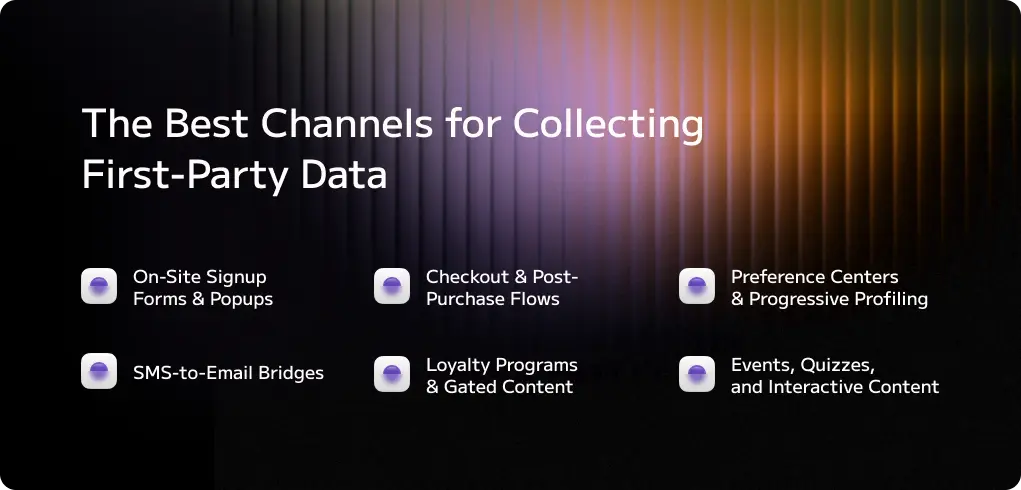
On-Site Signup Forms & Popups
Well-timed, well-designed popups remain one of the highest-ROI first-party data collection tools available. A popup that appears after genuine engagement – not the instant a visitor lands – converts far better and captures cleaner, higher-intent first-party data. We go deep into the setup of high-converting popups in our complete guide to pop-ups in email marketing.
Checkout & Post-Purchase Flows
Checkout is a moment of high trust, which makes it ideal for first-party data collection beyond just an email address. Birthday fields, product preferences, and SMS opt-in checkboxes placed thoughtfully at checkout convert well because the customer is already committed to the transaction.
Preference Centers & Progressive Profiling
Instead of asking for everything upfront, progressive profiling collects first-party data gradually, over multiple interactions. A preference center where subscribers choose content categories, purchase frequency, or product interests gives you rich first-party data while making the subscriber feel in control rather than interrogated.
SMS-to-Email Bridges
SMS and email work best as a coordinated first-party data engine rather than two separate channels. Cross-promoting each list to the other – with a clear incentive – builds first-party data across both channels simultaneously and increases the odds a customer stays reachable even if they disengage from one. We compare the strengths of each channel in depth in email vs. SMS: which channel drives more revenue.
Loyalty Programs & Gated Content
Loyalty programs are one of the most underused first-party data collection tools in eCommerce. Points, tiers, and referral rewards give customers a tangible reason to share more first-party data over time, and the right loyalty platform can sync that data directly into your email and SMS flows. If you’re evaluating loyalty and reviews platforms, our breakdown of the best Yotpo alternatives for reviews, loyalty, and SMS marketing is a useful starting point.
Events, Quizzes, and Interactive Content
Interactive content – quizzes, polls, product recommenders – is first-party data collection disguised as entertainment. Customers answer a few questions to get a personalized result, and you walk away with structured, zero-party-adjacent first-party data you can immediately act on. Klaviyo’s interactive email capabilities make this especially powerful; we walk through real setups in our guide to interactive emails in Klaviyo.
How to Turn Website Traffic Into First-Party Data Without Killing Conversion
The biggest mistake brands make with first-party data collection is treating every form as equally important and asking for too much, too soon. The fix is friction management: ask for the minimum viable information at each stage, and earn the right to ask for more later. A single email field converts dramatically better than a five-field form, even if that form theoretically captures richer first-party data. Collect the rest progressively, after trust has been established.
Incentive structure matters just as much as friction. A vague “join our newsletter” collects far less first-party data than a specific, valuable offer – a discount, early access, or a personalized recommendation. And timing your prompts to genuine engagement signals, rather than arbitrary page-load timers, consistently improves both opt-in rates and the long-term quality of the first-party data you collect.
First-Party vs. Zero-Party vs. Third-Party Data
| First-Party Data | Zero-Party Data | Third-Party Data | |
| Source | Your owned channels | Directly and voluntarily shared by the customer | Purchased or licensed from external providers |
| Accuracy | High | Very high | Declining and often unverifiable |
| Customer trust | High, if collected transparently | Highest, since it’s explicitly given | Low; customer has no relationship with you |
| Compliance risk | Low, with proper consent | Lowest | High, under GDPR/CCPA |
| Best use case | Segmentation, personalization, retention | Hyper-personalized recommendations | Legacy prospecting (rapidly shrinking) |
How We Structure First-Party Data Collection for Clients
In our work with eCommerce and DTC brands, the accounts that see the strongest gains treat first-party data collection as infrastructure, not a marketing tactic bolted on afterward. That means mapping every customer touchpoint – homepage, checkout, post-purchase, SMS, loyalty – and identifying exactly what data point each one is realistically positioned to capture. A checkout flow shouldn’t try to build a full customer profile in one step; it should capture one or two high-value fields and let the preference center do the rest over time.

We also treat Klaviyo as the operational hub for this first-party data, syncing signals from popups, forms, SMS, and on-site behavior into unified profiles that drive segmentation automatically. When first-party data collection and flow logic are built together from day one, brands typically see meaningful lifts in both list growth quality and downstream revenue per subscriber, because every campaign is built on data that actually reflects customer intent.
Common Mistakes That Kill Data Quality
Even well-intentioned first-party data collection efforts fail for predictable reasons. Asking for too much information too early scares off otherwise-interested visitors. Failing to explain why you’re asking for a data point reduces both opt-in rates and data honesty. Letting collected first-party data sit unused in a CDP without feeding it into actual segmentation wastes the entire effort. And neglecting to periodically re-confirm consent or clean stale profiles quietly erodes both compliance standing and deliverability.
Compliance Checklist for First-Party Data Collection
Collecting first-party data responsibly isn’t optional – it’s what keeps the whole strategy sustainable. Before scaling any collection channel, confirm:
- explicit opt-in consent is captured and timestamped;
- customers can easily view, update, or delete their data;
- your privacy policy clearly explains what first-party data is collected and why;
- SMS consent is captured separately from email consent, per TCPA requirements;
- your ESP or CDP supports data subject access requests under GDPR and CCPA.
Getting this right protects both the customer relationship and your sender reputation.
Ready to Turn Your Traffic Into First-Party Data?
If your current signup flows, popups, and post-purchase sequences aren’t converting traffic into usable first-party data, that’s revenue being left on the table every single day. Our team audits your entire collection funnel – from first popup to final Klaviyo flow – and builds a first-party data strategy designed around your actual customers. Reach out for a free audit and see exactly where your first-party data collection is underperforming.
FAQ
What is first-party data in marketing?
First-party data is information a business collects directly from its own customers through owned channels like its website, email list, SMS program, or app — as opposed to data purchased from external third parties.
Why is first-party data more important in 2026?
Third-party cookie deprecation, Apple's Mail Privacy Protection, and stricter privacy regulations have made external data sources less reliable and riskier to use, pushing brands to rely on first-party data for accurate targeting and personalization.
What's the difference between first-party and zero-party data?
First-party data is any data collected directly by a brand, including inferred behavioral data like browsing history. Zero-party data is a subset that customers explicitly and voluntarily share, such as stated preferences in a quiz.
How do you start collecting first-party data if you have none?
Start with a single, well-timed popup offering a clear incentive for an email signup, then expand into checkout fields, SMS opt-ins, and a preference center as trust builds.
Does first-party data collection require customer consent?
Yes. Under GDPR and CCPA, brands must obtain clear, documented consent before collecting and using customer data, and must offer customers a way to access or delete it.