
May Email Marketing Calendar: Key Dates and Campaign Ideas for Ecommerce
May is one of the most underrated months in ecommerce email marketing. Many brands slow down after April or wait for summer sales, but in reality, May offers massive opportunities if you plan ahead. That’s exactly why I always recommend building a structured May Email Marketing Calendar instead of sending campaigns reactively.
May sits at the intersection of spring momentum and early summer intent. Customers are more active, more optimistic, and more willing to spend — especially when your messaging aligns with seasonal emotions. A well-planned May Email Marketing Calendar helps brands stay consistent, relevant, and revenue-focused, while fitting naturally into a broader ecommerce calendar.
In this article, I’ll break down how I build a May Email Marketing Calendar for ecommerce brands, which key dates matter most, and what campaign ideas actually perform.
Why May Is a Critical Month in Your Ecommerce Calendar
From a strategic perspective, May plays a very specific role in the yearly ecommerce calendar.
A strong May Email Marketing Calendar helps you:
- Capitalize on spring buying behavior
- Prepare audiences for summer promotions
- Leverage gifting-driven holidays
- Maintain momentum before major summer sales
Unlike Q4-heavy months, May allows more creativity and flexibility. That makes your May Email Marketing Calendar the perfect testing ground for new offers, messaging angles, and product positioning.
How May Fits into a Full-Year Ecommerce Calendar
Every month in a well-built ecommerce calendar has a purpose. May typically supports three high-level goals:
- Spring-to-summer transition
- Gifting-focused campaigns
- Audience engagement and list growth
Your May Email Marketing Calendar should reflect all three — not just promotions.
Key Dates to Include in Your May Email Marketing Calendar
Not every brand needs every holiday. The key is relevance. Below are the most commonly used anchor dates in a high-performing May Email Marketing Calendar.
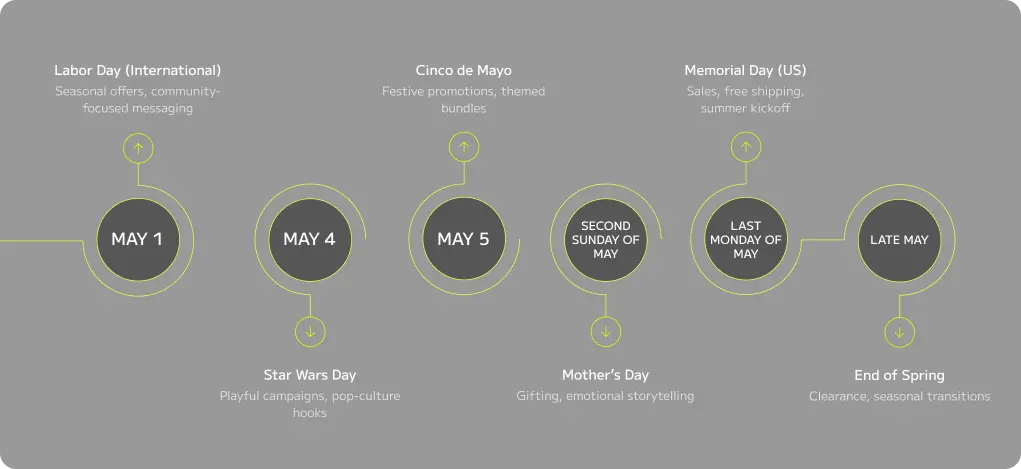
Key Dates Table — May Email Marketing Calendar
| Holiday / Event | Date | Campaign Theme |
| Labor Day (International) | May 1 | Seasonal offers, community-focused messaging |
| Star Wars Day | May 4 | Playful campaigns, pop-culture hooks |
| Cinco de Mayo | May 5 | Festive promotions, themed bundles |
| Mother’s Day | Second Sunday of May | Gifting, emotional storytelling |
| Memorial Day (US) | Last Monday of May | Sales, free shipping, summer kickoff |
| End of Spring | Late May | Clearance, seasonal transitions |
Major Campaign Opportunities in May
Let’s break down how these dates fit into a real May Email Marketing Calendar, starting with the most impactful ones.
Mother’s Day Campaigns (Mid-May)
Mother’s Day is often the top-performing event in a May ecommerce calendar, especially for:
- Beauty and skincare
- Fashion and accessories
- Home and lifestyle
- Wellness brands
A strong May Email Marketing Calendar usually includes multiple Mother’s Day touchpoints, not just one email.
Recommended email types:
- Gift guides
- Last-minute reminders
- Digital gift card promotions

Memorial Day Campaigns (End of May)
For US-based brands, Memorial Day acts as a soft summer sale.
In a May Email Marketing Calendar, Memorial Day campaigns often focus on:
- Limited-time discounts
- Free shipping offers
- “Summer starts now” messaging
- Gratitude and support
This is where promotional intensity typically increases.
Cinco de Mayo and Pop-Culture Moments
Dates like Cinco de Mayo or Star Wars Day work best as lightweight engagement campaigns.
They add personality to your May Email Marketing Calendar without overwhelming your list.
Examples:
- Themed subject lines
- Fun product bundles
- Limited-edition visuals
Weekly Structure for a May Email Marketing Calendar
Instead of thinking of isolated holidays, I recommend structuring your May Email Marketing Calendar by weeks.
Weekly Breakdown Table — May Email Marketing Calendar
| Week | Focus | Email Types |
| Week 1 | Engagement & awareness | Storytelling, seasonal content |
| Week 2 | Gifting preparation | Gift guides, product highlights |
| Week 3 | Peak conversion | Mother’s Day promos, reminders |
| Week 4 | Sales & transition | Memorial Day offers, summer teasers |
Campaign Ideas That Perform Well in May
Over time, certain campaigns consistently perform well in a May Email Marketing Calendar, regardless of niche.
Seasonal Refresh Campaigns
May is ideal for “refresh” messaging:
- Spring-to-summer collections
- Updated bundles
- Limited seasonal SKUs
These campaigns align naturally with a seasonal ecommerce calendar.
Gift-Focused Email Sequences
Gifting is central to May.
Effective May Email Marketing Calendar sequences often include:
- “For every type of mom” emails
- Personalized recommendations
- Urgency-driven reminders
Short, High-Impact Promotions
Instead of one long sale, May works best with short promotional bursts:
- 48–72-hour offers
- Exclusive segments
- Bonus gifts
This keeps your ecommerce calendar dynamic and flexible.
Content vs Promotion Balance in May
One common mistake I see is overloading May with discounts.
A healthy May Email Marketing Calendar usually looks like:
- ~60% value and seasonal content
- ~40% promotional messaging
This balance keeps engagement high while still driving revenue.
Integrating the May Email Marketing Calendar with Other Channels
Email performs best when aligned with the rest of your ecommerce calendar.
Your May Email Marketing Calendar should work alongside:
- SMS reminders
- Paid social campaigns
- On-site promotions
- WhatsApp or push notifications
Common Mistakes in May Email Marketing Calendars
Even strong brands make avoidable mistakes in May.
Treating May Like a “Quiet Month”
May is not slow — it’s strategic.
Over-Focusing on One Holiday
A strong May Email Marketing Calendar spreads attention across the month.
Ignoring Non-Gifting Audiences
Not everyone buys for Mother’s Day — your ecommerce calendar should reflect that.
My Recommended May Email Marketing Calendar Framework
Here’s the framework I use for most ecommerce brands:
May Email Marketing Calendar Framework
| Element | Recommendation |
| Total campaigns | 8–12 emails |
| Promotional ratio | ~40% |
| Content ratio | ~60% |
| Core focus | Gifting + seasonal transition |
This framework scales well and fits seamlessly into a long-term ecommerce calendar.
Final Thoughts
A clear May Email Marketing Calendar removes guesswork from your strategy. Instead of reacting to deadlines, you execute with confidence and consistency.
When May is aligned with your broader ecommerce calendar, email becomes a predictable growth channel — not a last-minute tactic.
If you’re building or refining your May Email Marketing Calendar, this is exactly the type of structure we use to help ecommerce brands grow month after month. Looking for support? Contact our team for a free consultation.
FAQ
What is a May Email Marketing Calendar?
A May Email Marketing Calendar is a structured plan outlining key dates, campaigns, and email themes for May in ecommerce.
Is May a good month for email promotions?
Yes. May supports gifting, seasonal transitions, and early summer sales.
How many emails should I send in May?
Most brands perform best with 2–3 campaigns per week, depending on list size.
Should every ecommerce brand run Mother’s Day campaigns?
No. Your ecommerce calendar should reflect your audience and product relevance.
Can a May Email Marketing Calendar increase revenue?
Absolutely. Planning ahead consistently leads to stronger campaign performance.