
Klaviyo Pricing Explained: Is It Worth It for Ecommerce?
If you’re running an ecommerce brand in 2026, understanding Klaviyo pricing is a core part of your profitability model. At first glance, Klaviyo pricing can seem straightforward. However, once your business starts scaling, the way Klaviyo pricing evolves becomes far more important than the starting cost itself.
Most brands don’t struggle with Klaviyo pricing because it’s “too expensive.” They struggle because they don’t fully understand how Klaviyo pricing scales, what drives increases, and how to align it with revenue. That’s exactly what I’m going to break down here — with real numbers and real scenarios.
How Klaviyo Pricing Works in 2026
To begin with, Klaviyo pricing is based on the number of active profiles (contacts) stored in your account. Unlike many traditional platforms, Klaviyo pricing does not depend on the number of emails you send. Instead, you pay for the size of your database.
This means you can send unlimited campaigns and flows, but your Klaviyo pricing increases as your contact list grows. Because of this, Klaviyo pricing becomes directly tied to how well you manage and monetize your audience.
Understanding how Klaviyo pricing scales over time is critical. Klaviyo pricing is not static — it grows alongside your business, which means your strategy must evolve as your list expands. Brands that plan ahead for Klaviyo pricing changes avoid sudden cost spikes and maintain stable profitability.
Klaviyo Pricing Tiers (2026 Data)
Now let’s move from theory to real numbers, because Klaviyo pricing only makes sense when you see actual benchmarks.
- Free plan: up to 250 contacts, 500 emails/month
- 500 contacts: ~$20/month
- 1,000 contacts: ~$30–45/month
- 5,000 contacts: ~$100/month
- 10,000 contacts: ~$150/month
- 25,000 contacts: ~$400/month
- 50,000 contacts: ~$720/month
- 250,000 contacts: ~$2,300/month
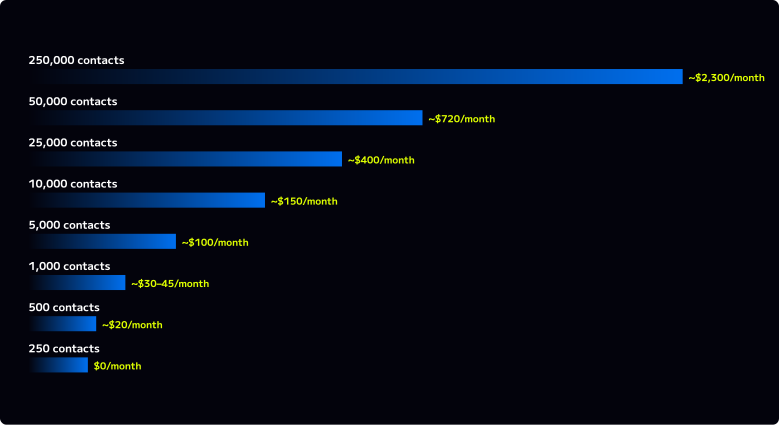
At this point, it becomes clear that Klaviyo pricing scales progressively. The more your business grows, the more you invest — but at the same time, your revenue potential also increases.
What’s Included in Klaviyo Pricing
When evaluating Klaviyo pricing, it’s important to understand what you actually get for your money. At a base level, Klaviyo pricing includes:
- Email marketing (unlimited sends)
- Automation flows
- Advanced segmentation
- Core analytics
However, Klaviyo pricing does not include everything. Additional channels and features often come at an extra cost, including:
- SMS marketing
- WhatsApp messaging
- Reviews tools
- Advanced data features
When evaluating tools, it’s important to look at Klaviyo pricing in the context of features. Klaviyo pricing includes powerful automation and segmentation capabilities that many cheaper platforms simply don’t offer.
Hidden Costs in Klaviyo Pricing
At this stage, Klaviyo pricing may still look predictable. But in practice, there are several hidden factors that significantly impact your monthly cost.
First, Klaviyo pricing includes all profiles — even inactive ones. This means that old or unengaged subscribers continue to increase your bill unless you actively manage your list.
Second, Klaviyo pricing can change automatically. If your contact count exceeds your current plan, the platform upgrades your account, which can lead to unexpected increases.
Third, Klaviyo pricing does not include SMS by default. SMS campaigns are billed separately, typically starting around $0.01 per message, depending on the region.
This is why Klaviyo pricing can feel unpredictable for brands that don’t actively manage their lists. Proper control over Klaviyo pricing starts with list hygiene, segmentation, and a regular database audit.
Looking to audit your Klaviyo account? Check out IMPRO Email Agency audit.
Real Monthly Klaviyo Pricing by Business Size
To make Klaviyo pricing more tangible, let’s look at real-world ranges.
For small ecommerce brands, Klaviyo pricing typically falls between $150 and $500 per month. At this stage, the focus should be on building flows and maximizing early ROI.
For mid-sized brands, Klaviyo pricing usually ranges from $500 to $2,000 per month. Here, segmentation and automation become critical for maintaining profitability.
For larger brands, Klaviyo pricing can exceed $2,000–$3,500 per month. However, at this level, email often becomes one of the highest revenue-driving channels.
Why Klaviyo Pricing Feels Expensive (But Isn’t)
This is where perspective matters.
On the surface, Klaviyo pricing may appear higher than alternatives. However, comparing Klaviyo pricing purely by cost misses the bigger picture. The real question is not how much Klaviyo costs — it’s how much revenue it generates.
Brands that treat Klaviyo pricing as an investment rather than an expense consistently outperform those that focus only on reducing costs.
Klaviyo Pricing vs ROI
When you connect Klaviyo pricing with performance, the picture changes completely.
Many ecommerce brands see returns of 30–50x on their email marketing investment. In this context, Klaviyo pricing becomes one of the most efficient growth drivers available.
Paying $1,000 per month for Klaviyo pricing to generate $30,000–$50,000 in revenue is not expensive — it’s highly profitable.
When Klaviyo Pricing Is Worth It
Klaviyo pricing makes the most sense when it is used as a full retention system rather than just a newsletter tool.
If your strategy includes:
- automated flows
- advanced segmentation
- lifecycle marketing
Then Klaviyo cost becomes fully justified.
Learn more here.
When Klaviyo Pricing Is NOT Worth It
At the same time, Klaviyo pricing is not always the right fit.
If you are:
- sending only occasional campaigns
- not using automation
- not tracking revenue
Then Klaviyo pricing will feel high relative to the value you get.
How to Reduce Klaviyo Pricing Without Losing Growth
The key to optimizing Klaviyo pricing is not cutting features — it’s improving efficiency.
Start by cleaning your list regularly. Removing inactive profiles immediately reduces Klaviyo pricing.
Next, focus on segmentation. Sending emails only to engaged users improves both performance and cost efficiency.
Finally, continuously audit your flows and campaigns. Better targeting means higher revenue per subscriber, which offsets Klaviyo pricing.
Klaviyo Pricing vs Other Platforms
When comparing Klaviyo pricing to competitors, cost alone doesn’t tell the full story.
See our full Attentive vs Klaviyo comparison guide here.
Klaviyo vs Mailchimp: this article will help you select the best solution for your business.
Klaviyo pricing is often higher, but it is backed by deeper data, stronger automation, and better revenue attribution.
Setting Up Klaviyo Correctly (Critical for Pricing Efficiency)
Even the best Klaviyo pricing structure won’t help if your account is set up incorrectly.
A proper setup ensures that Klaviyo pricing translates into measurable revenue instead of wasted budget. You’ll find a detailed guide here.
Expanding Beyond Email: How Channels Affect Klaviyo Pricing
In 2026, Klaviyo pricing reflects more than just email.
With the addition of SMS and WhatsApp, Klaviyo pricing now represents a full multi-channel marketing system.
This makes Klaviyo pricing more complex — but also significantly more powerful, find out the details here.
Final Thoughts
After breaking everything down, the conclusion is clear.
Klaviyo pricing is absolutely worth it — but only if you use the platform strategically.
If you build proper flows, segment your audience, and continuously optimize performance, Klaviyo pricing becomes one of the highest ROI investments in your business.
If not, it simply becomes another expense.
FAQ
How much does Klaviyo cost per month?
Klaviyo pricing starts at around $20/month and scales based on the number of contacts.
Does Klaviyo charge per email?
No, Klaviyo pricing is based on contacts, not the number of emails sent.
Why does Klaviyo pricing increase over time?
Because your contact list grows, and Klaviyo pricing scales with it.
How can I control Klaviyo pricing?
By cleaning your list, segmenting users, and optimizing engagement.
Is Klaviyo pricing better than cheaper tools?
Klaviyo pricing is higher, but it offers significantly more revenue potential for ecommerce brands.