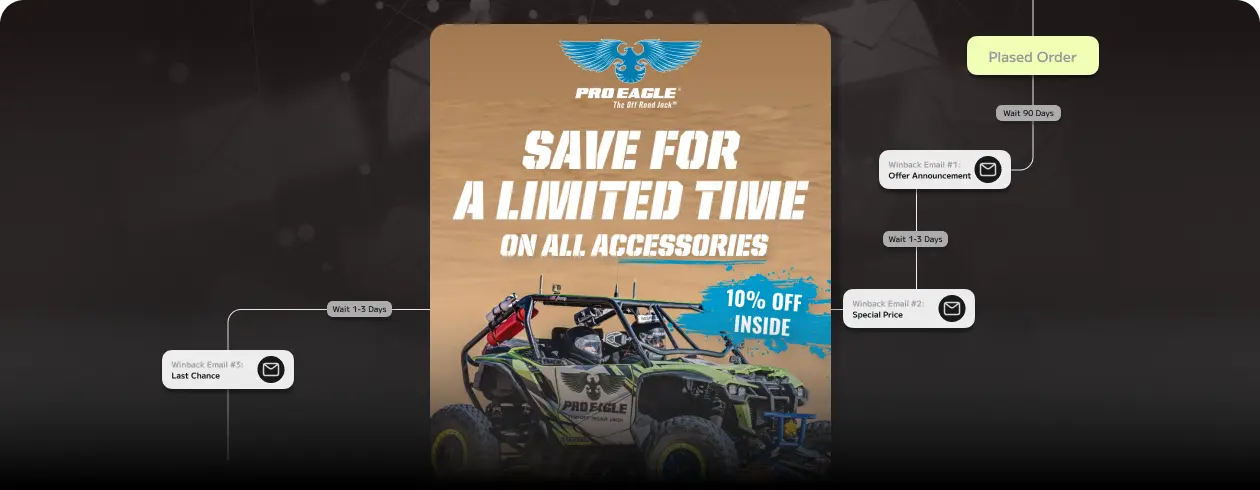
Importance of Win-Back Flow After the Holiday Season
The holiday season is one of the most profitable periods for ecommerce brands in the US. Sales increase, email lists grow rapidly, but customer acquisition costs temporarily grow. Once the holiday rush is over, many brands experience the same painful pattern: engagement declines, open rates fall, and a large portion of holiday buyers simply disappear.
This is exactly where a win-back email flow becomes not just helpful, but absolutely critical.
From my experience working with US-based ecommerce brands, I’ve seen one clear trend again and again. Brands that launch a structured win-back email flow immediately after the holiday season recover faster, stabilize revenue earlier, and protect their email deliverability long-term.
Before we talk about tactics, though, it’s important to understand why post-holiday disengagement happens in the first place.
Let’s dive deeper!
Why Engagement Drops After the Holiday Season
The holiday season creates buying behavior that is not sustainable year-round. Customers shop differently, spend more freely, and respond faster to promotions. As a result, email engagement metrics during Q4 are often misleading.
Once January hits, several things happen almost simultaneously.
First, inbox fatigue becomes real. Customers have been bombarded with promotions for weeks, sometimes months. Second, spending priorities shift, especially in the US market where consumers refocus on budgeting. And third, the emotional urgency of holiday shopping disappears overnight.
Because of this, many subscribers who were highly active in November and December suddenly go silent.
However, silence doesn’t mean disinterest forever.
Instead, it signals the need for a win-back and other re-engagement email flows that are designed specifically for post-holiday behavior.
Post-holiday disengagement isn’t a churn problem — it’s a messaging problem.
What a Win-Back Email Flow Actually Is
Before going further, let’s clarify what I mean by a win-back email flow.
A win-back email flow is an automated email sequence designed to re-engage subscribers or customers who have stopped opening, clicking, or purchasing — but are still valuable to your business.
Importantly, a win-back email flow is not the same as a standard promotional campaign or sunset flow.
Instead, a win-back email flow focuses on:
- Rebuilding interest
- Reminding customers of value
- Addressing post-holiday fatigue
- Gradually reintroducing brand relevance
When executed correctly, a win-back email flow delivers high ROI in your entire email marketing strategy.
Why the Holiday Season Makes Win-Back Email Flows Even More Important
After the holidays, your email list is usually larger than ever. You’ve acquired new subscribers through ads, gift guides, discounts, pop-ups, and seasonal campaigns.
However, many of those subscribers joined for a single reason: holiday deals.
This is where a win-back email flow plays a strategic role.
Instead of letting those subscribers decay silently — hurting both profitability (after purchasing advertisements, etc.) and deliverability — a win-back email flow allows you to:
- Identify who is worth re-engaging
- Filter out low-intent subscribers
- Protect sender reputation
- Recover revenue that would otherwise be lost
In other words, the win-back email flow becomes a cleanup and recovery mechanism after Q4 chaos.
See more on email marketing deliverability here.
Win-Back Email Flow vs re-engagement Flows
At this point, it’s important to distinguish between a win-back and re-engagement
Although they are related, they serve different purposes.
| Aspect | Win-Back Email Flow | Re-engagement Flow |
| Automation | Fully automated | Fully automated |
| Timing | Triggered by inactivity | Triggered by inactivity/action |
| Personalization | High | Medium |
| Long-term impact | Strong | Strong |
| Deliverability benefit | Strong | Medium |
A win-back email flow continuously protects your list quality, especially after the holiday season when disengagement spikes, while a re-engagement flow is the point of contact before the win-back and does not clean your list or provide customers with strong incentives.
When to Trigger a Win-Back Email Flow After Holidays
Timing is everything.
If you set trigger timing for win-back email flow too early, it can annoy subscribers who are simply taking a break. Launching it too late can permanently lose them.
Based on performance data from US ecommerce brands, the optimal triggers for a win-back email flow after the holidays are:
- No opens in 30–45 days
- No clicks in 45–60 days
- No purchase since holiday season
This timing respects post-holiday fatigue while still acting before disengagement becomes permanent.
Structure of a High-Converting Win-Back Email Flow
Now let’s talk about structure.
A strong win-back email flow is not aggressive. It is progressive, value-driven, and psychologically smart.
Here’s a proven structure I consistently recommend.
Email 1: Gentle Reminder
The first email in your win-back email flow should feel light and low-pressure.
Focus on brand value, not discounts.
Example messaging:
- “Still interested?”
- “Here’s what you’ve missed”
- “A quick hello from us”
Lifestyle product image or brand story visual with some inspiring words from the brand.
Email 2: Value Reintroduction
If there’s still no engagement, the second email in the win-back email flow should reinforce why your brand matters.
This is where education, social proof, or best-sellers work well.
Email 3: Incentive-Based Re-Engagement
At this stage, the win-back email flow can introduce an incentive — but carefully.
The goal is not to train customers to wait for discounts, but to remove friction.
Examples:
- Free shipping
- Limited-time bonus
- Loyalty points
Email 4: Manage Preference Email
Finally, every win-back email flow should end with a clear understanding if these contacts are re-engaged or if weblogs them to a sunset flow and suppress if inactive.
Ask how often they want to receive emails or which type of content they are interested in. If there’s still no reaction, set up a sunset flow with appropriate triggers.
A smaller engaged list will always outperform a large disengaged one.
See here how to develop a strategy for email marketing that converts.
How to Build a Win-Back Email Flow in Klaviyo
Now that we’ve covered why a win-back email flow is essential after the holiday season and its structure, it’s worth briefly talking about how to implement it — especially if you’re using Klaviyo.
In practice, Klaviyo is one of the most flexible platforms for building a scalable win-back email flow, particularly for US-based ecommerce brands. Its behavioral tracking, segmentation logic, and revenue attribution make it ideal for post-holiday re-engagement.
What matters most here is not complexity, but structure.
In Klaviyo, I usually recommend building a dedicated win-back email flow based on inactivity signals rather than calendar timing. This ensures that every subscriber enters the flow when their engagement drops — not when you assume it should.
Recommended Klaviyo Triggers for a Win-Back Email Flow
Inside Klaviyo, a high-performing win-back email flow typically starts with one of the following triggers:
- Has not opened an email in the last 30–45 days
- Has not clicked in the last 45–60 days
- Has not placed an order since the holiday season date
These conditions allow Klaviyo to automatically identify post-holiday drop-off and enroll subscribers in the win-back email flow at the right moment.
Just as important, Klaviyo lets you add conditional splits based on past purchase behavior, AOV, or product category. This is where the win-back email flow becomes truly personalized.
Why Klaviyo Makes Win-Back Email Flows More Effective
One of the biggest advantages of building a win-back email flow in Klaviyo is visibility.
With Klaviyo, you can clearly see:
- Revenue generated by the win-back email flow
- Engagement trends at each step
- Drop-off points inside the flow
- Long-term reactivation impact
This data makes it easier to optimize your win-back email flow over time instead of guessing what works.
Pro Tip: Exclude Recent Purchasers in Klaviyo
One small but critical detail many brands miss is exclusion logic.
In Klaviyo, always exclude subscribers who have purchased in the last 7–14 days from entering your win-back email flow. This prevents awkward timing and protects customer experience — especially after the holiday season, when delayed purchases are common.
How a Win-Back Email Flow Improves Deliverability
One of the most overlooked benefits of a win-back email flow is deliverability.
After the holiday season, inbox providers closely monitor engagement signals. If you keep sending campaigns to inactive users, your sender reputation suffers.
A properly built win-back email flow helps by:
- Reducing inactive subscribers
- Increasing positive engagement signals
- Preventing spam complaints
- Supporting inbox placement
In the long run, this directly impacts how all your emails perform.
Measuring the Success of a Win-Back Email Flow
To evaluate your win-back email flow, focus on the metrics that matter.
| Metric | Why It Matters |
| Recovered revenue | Direct ROI |
| Re-engagement rate | Flow effectiveness |
| Unsubscribe rate | List hygiene |
| Spam complaints | Deliverability health |
If your win-back email flow is working correctly, you should see steady reactivation without spikes in unsubscribes.
Common Mistakes Brands Make After the Holidays
Despite good intentions, many brands sabotage their own win-back email flow.
The most common mistakes include:
- Using heavy discounts too early
- Sending too many emails
- Forgetting mobile optimization
- Not excluding recent purchasers
Avoiding these mistakes alone can significantly improve win-back email flow performance.
Need analysis of your strategy or just a consultation? Contact us here for a free audit.
Final Thoughts
To sum it up, the holiday season doesn’t end when December does. Its impact carries into Q1 — for better or worse.
A well-designed win-back email flow allows you to control that transition instead of reacting to declining metrics.
For US ecommerce brands, especially those scaling aggressively, a win-back email flow is no longer optional. It’s a core retention asset that protects revenue, engagement, and long-term growth.
If you’re serious about turning post-holiday silence into sustainable revenue, your next step should be simple: audit your current win-back email flow — or build one if it doesn’t exist yet.
FAQ
What is a win-back email flow?
A win-back email flow is an automated email sequence designed to re-engage inactive subscribers or customers who have stopped opening, clicking, or purchasing. After the holiday season, a win-back email flow helps brands recover engagement, protect deliverability, and generate additional revenue from existing lists.
Why is a win-back email flow important after the holiday season?
After the holiday season, engagement naturally drops due to inbox fatigue and changing spending habits. A win-back email flow allows brands to proactively address this drop, reintroduce value, and prevent long-term subscriber churn while maintaining a healthy email list.
When should I launch a win-back email flow?
For most US ecommerce brands, a win-back email flow should trigger when a subscriber shows 30–60 days of inactivity. Post-holiday win-back email flows work best when they activate early enough to recover interest, but not so early that they feel intrusive.
Should I use discounts in a win-back email flow?
Discounts can be effective in a win-back email flow, but they should be used strategically. I recommend introducing incentives only after value-based messaging has failed. This approach prevents customers from expecting discounts as the only reason to re-engage.