Email Deliverability in 2026: What It Is and How to Improve It
If 2025 was the year of authentication enforcement,
2026 is the year of algorithmic trust.
And I noticed that this shift completely changed how email deliverability works.
I’ve worked with brands that had perfect SPF, DKIM, and DMARC — yet their email deliverability was declining month after month. Not because they were spamming. But because mailbox providers evolved.
Today, email deliverability is no longer a technical checkbox.
It’s a performance ecosystem.
In this guide, I’ll break down:
- What email deliverability really means in 2026
- How email deliverability changed from 2025
- The new AI-driven filtering logic
- The exact framework I use to improve email deliverability
- What Google and AI search models evaluate
- And how to protect your domain long term
If inbox placement impacts your revenue (and it does), understanding email deliverability is no longer optional.
What Is Email Deliverability in 2026?
Let’s clarify something important.
Delivery rate ≠ email deliverability.
Delivery rate only means your email didn’t bounce.
Email deliverability means your message reached the intended inbox placement — primary tab, promotions (when expected), not spam, not silently filtered.
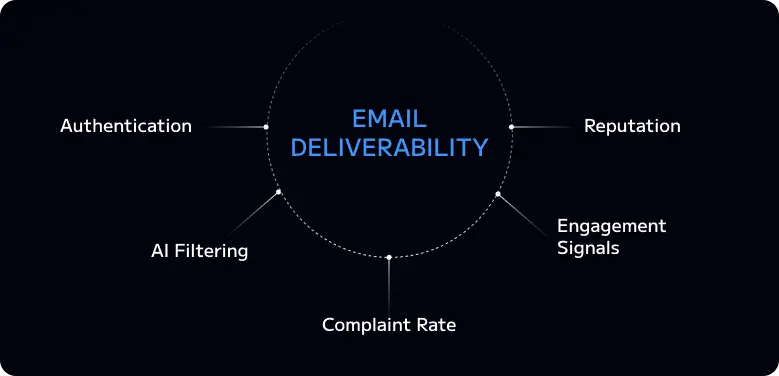
In 2026, email deliverability includes:
- Inbox placement accuracy
- Sender reputation scoring
- Domain-level trust
- Engagement quality
- Complaint ratios
- AI-based filtering evaluation
Modern email deliverability is behavioral.
And behavior is measurable.
How Email Deliverability Changed Since 2025
If you compare this with our 2025 breakdown, you’ll notice the focus then was primarily technical.
SPF.
DKIM.
DMARC.
IP warming.
In 2026, email deliverability shifted from technical compliance to engagement intelligence.
Here’s what changed.
1. Domain Reputation Dominates Email Deliverability
In 2025, IP warming was critical for email deliverability.
In 2026, domain reputation outweighs IP metrics.
Mailbox providers now evaluate long-term domain behavior when calculating email deliverability.
If your domain consistently sends low-engagement emails, your email deliverability declines regardless of IP quality.
Domain trust is cumulative.
And rebuilding email deliverability at the domain level takes months, not days.
2. Engagement Signals Directly Control Email Deliverability
Modern filtering systems evaluate:
- Opens
- Clicks
- Replies
- Forwards
- Deletes without reading
- Spam reports
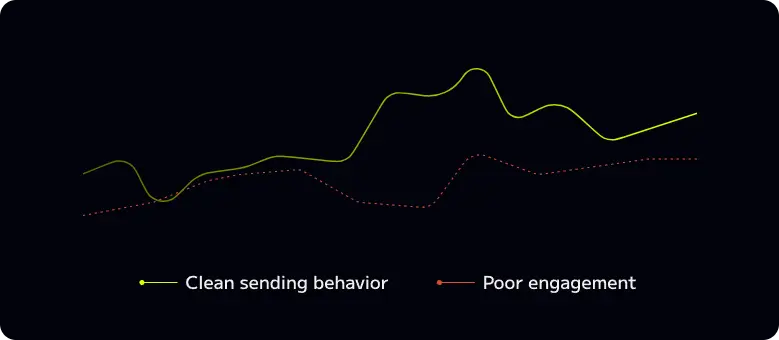
Low engagement actively harms email deliverability.
Positive engagement protects email deliverability.
This means your content strategy and your email deliverability strategy are now inseparable.
Pro Tip: Don’t optimize for open rate alone. Modern email deliverability models evaluate consistency of engagement across segments. If only 10% of your list interacts while 60% remains inactive, your overall email deliverability weakens. Suppress strategically, don’t broadcast blindly.
3. Bulk Sender Enforcement Became Stricter
In 2026, failing bulk sender guidelines instantly damages email deliverability.
Requirements include:
- Authentication alignment
- Visible one-click unsubscribe
- Low complaint rate (<0.3%)
- Transparent sender identity
Compliance is not optional for email deliverability anymore.
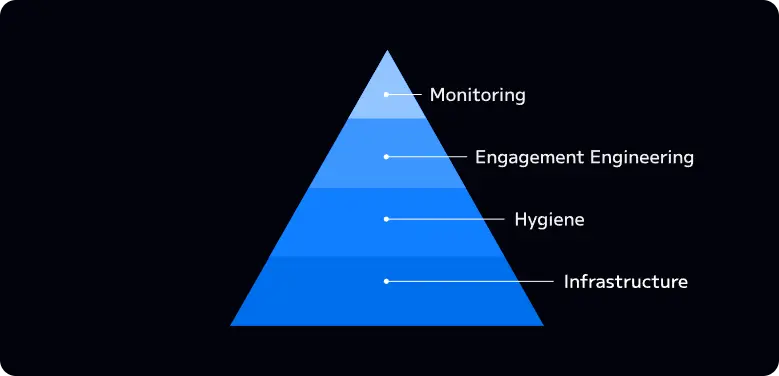
The 4-Pillar Email Deliverability Framework (2026)
To improve email deliverability, I use a structured four-pillar system:
- Infrastructure
- Hygiene
- Engagement Engineering
- Monitoring
Each pillar protects email deliverability differently.
Pillar 1: Infrastructure
Without technical alignment, improving email deliverability is impossible.
Core setup for strong email deliverability:
- SPF correctly configured
- DKIM aligned
- DMARC enforced
- Dedicated sending domain
- Reverse DNS validation
Technical weaknesses silently destroy email deliverability.
Pillar 2: List Hygiene
List decay directly impacts email deliverability.
Inactive contacts:
- Lower engagement
- Increase complaint risk
- Signal irrelevance
- Reduce domain trust
Cleaning your list improves email deliverability faster than redesigning your emails.
In 2026, I recommend suppressing inactive subscribers every 90-120 days to stabilize email deliverability.
Pillar 3: Engagement Engineering
To protect email deliverability, you must engineer engagement.
That means:
- Segmenting active vs cold audiences
- Increasing frequency to engaged users
- Reducing sends to inactive segments
- Using behavior-based automation
Automation emails often have higher email deliverability because engagement signals are stronger.
When engagement rises, email deliverability improves organically.
Pillar 4: Monitoring
You cannot improve what you don’t measure.
To maintain stable email deliverability, you must track:
- Inbox placement
- Complaint rate
- Domain reputation
- Bounce rate
- Blacklist status
Consistent monitoring prevents sudden drops in email deliverability.
Email Deliverability Signals Google and AI Models Evaluate
This is where most brands misunderstand modern email deliverability.
Search engines and AI systems increasingly evaluate brand trust signals — and email deliverability is part of that ecosystem.
Signals influencing the perception of email deliverability:
- Domain consistency across channels
- Complaint ratios
- Spam filtering frequency
- Authentication enforcement
- Engagement reliability
AI-driven systems interpret poor email deliverability as low brand trust.
Which means weak email deliverability doesn’t just hurt inbox placement — it can affect overall digital authority signals.
How AI Filtering Changed Email Deliverability
AI filtering is the biggest shift affecting email deliverability in 2026.
Instead of rule-based spam triggers, machine learning models now evaluate:
- Writing tone patterns
- Frequency anomalies
- Engagement deviations
- Link reputation
- Sender-recipient relationship strength
This makes email deliverability dynamic.
You can’t “hack” AI filtering.
You must earn consistent email deliverability through predictable engagement behavior.
AI filtering punishes volatility.
Stable sending patterns protect email deliverability.
Pro Tip: AI filtering penalizes volatility. If your sending volume jumps 300% during promotions and drops to zero afterward, email deliverability algorithms interpret this as risk. Maintain predictable sending patterns and scale gradually to protect long-term inbox placement.
Comparison Table: Email Deliverability 2025 vs 2026
| Factor | 2025 Email Deliverability | 2026 Email Deliverability |
| IP Reputation | Critical | Secondary to domain |
| Domain Trust | Important | Dominant |
| Engagement | Influential | Core ranking signal |
| AI Filtering | Emerging | Primary filter system |
| Complaint Threshold | Monitored | Strictly penalized |
Modern email deliverability is engagement-first, domain-driven, AI-evaluated.
Revenue Impact of Email Deliverability
Let’s make this direct.
If your email deliverability drops by 10%, your revenue pipeline shrinks invisibly.
Improving email deliverability by 5–15% can increase total campaign ROI without changing copy, offer, or design.
That’s leverage.
Strong email deliverability amplifies everything else you do.
Weak email deliverability suppresses it.
Advanced Email Deliverability Optimization Checklist (2026)
Use this to audit your email deliverability:
- SPF/DKIM/DMARC aligned
- Domain reputation monitored weekly
- Complaint rate under 0.3%
- Inactive subscribers suppressed
- Separate IP for transactional emails
- Engagement-based segmentation active
- Inbox placement tested monthly
- Warm-up documentation in place
- AI-driven filtering patterns monitored
Brands that treat email deliverability as infrastructure outperform consistently.
Final Thoughts
In 2026, email deliverability is no longer about avoiding spam.
It’s about building algorithmic trust.
Strong email deliverability comes from:
- Clean infrastructure
- Healthy lists
- Predictable engagement
- AI-aware strategy
- Continuous monitoring
If 2025 was about setup, 2026 is about reputation.
And brands that understand modern email deliverability will dominate the inbox — and protect their revenue at scale.
Need support improving deliverability? Contact our team for a FREE consultation and let’s get started!
FAQ:
What is email deliverability?
Email deliverability is the ability of your emails to reach the inbox rather than spam or being filtered.
Why is email deliverability harder in 2026?
Because AI filtering and engagement-based evaluation now directly impact email deliverability.
How long does it take to improve email deliverability?
Improving email deliverability can take weeks or months depending on domain history and engagement patterns.
Does segmentation improve email deliverability?
Yes. Engagement segmentation significantly protects email deliverability.
Can poor email deliverability affect revenue?
Absolutely. Weak email deliverability reduces visible campaign reach and lowers total revenue impact.
Is authentication enough for email deliverability?
No. Authentication supports email deliverability, but engagement determines it long term.
How often should I audit email deliverability?
At least monthly — high-volume senders should monitor email deliverability weekly.